VAR vs Replay: Decision Control
Video Assistant Referee (VAR) is an officiating system used in football competitions worldwide, including FIFA tournaments, UEFA Champions League matches, and domestic leagues. It reviews match-changi...

VAR vs Replay: Decision Control
Video Assistant Referee (VAR) is an officiating system used in football competitions worldwide, including FIFA tournaments, UEFA Champions League matches, and domestic leagues. It reviews match-changing referee decisions from a dedicated video operation room, then recommends a correction only when there is a “clear and obvious error” or a serious missed incident. VAR covers four categories: goal or no goal, penalty or no penalty, direct red cards, and mistaken identity. The referee remains responsible for the final decision. A VAR team uses multiple camera angles, slow motion, goal-line technology where available, and calibrated offside tools. The International Football Association Board (IFAB) protocol sets no fixed maximum review time, because accuracy has priority over speed. The practical takeaway is simple: do not expect VAR to re-referee every challenge; watch whether the incident fits one of the four categories and whether the evidence clearly overturns the original call.
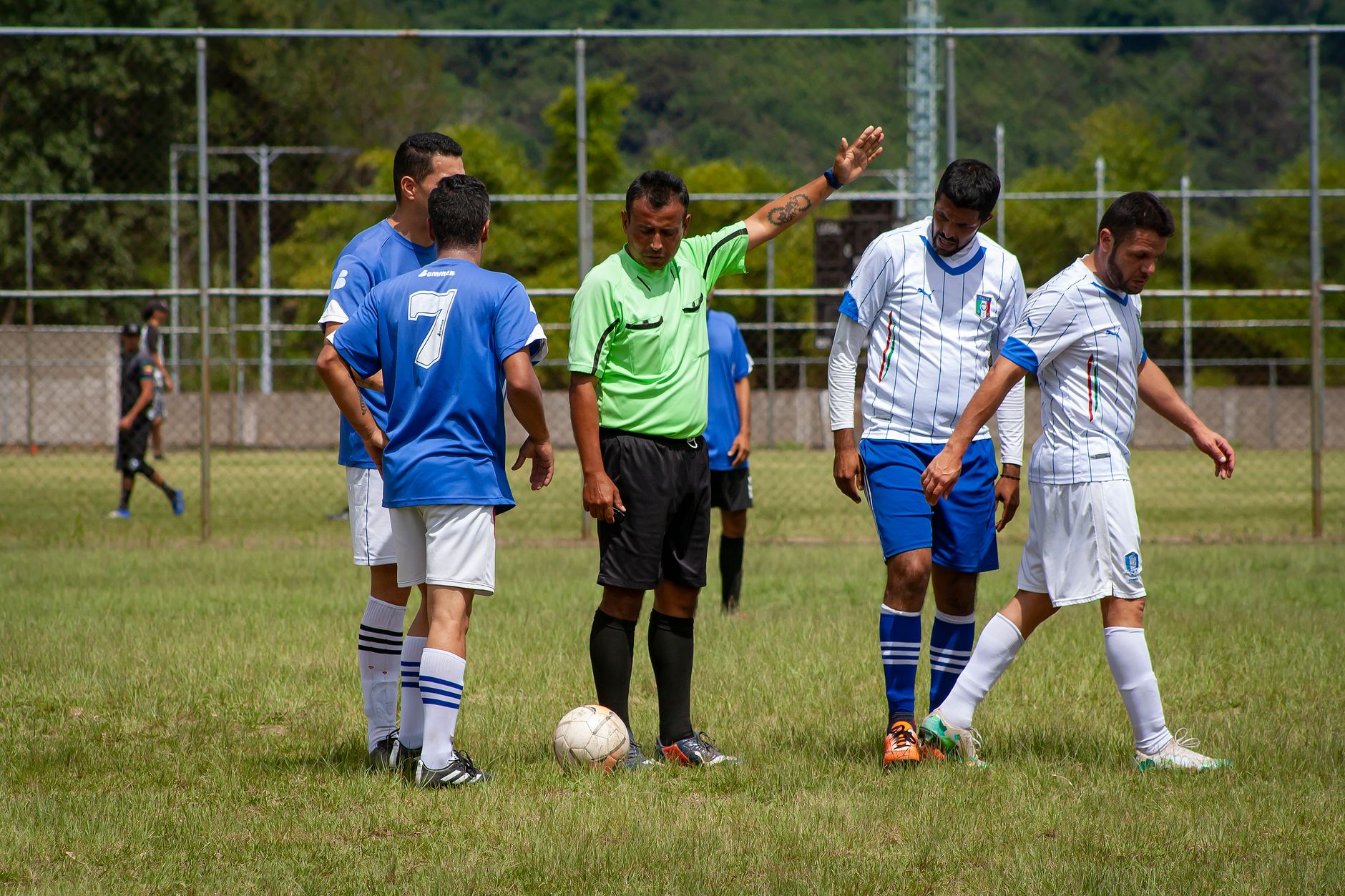
Photo by Arturo Añez. on Pexels
Want a clearer view of match decisions and tournament context? Goal Moments tracks FIFA World Cup fixtures, tactics, player statistics, and officiating developments.
If a goal is scored: check the complete attacking phase
VAR checks goals by reviewing whether an offence occurred before the ball crossed the goal line, including offside, handball, fouls, or an incorrect restart. The referee’s final decision remains decisive, and the review is limited by the applicable restart point and competition protocol.
The most important detail is timing. A goal is not treated as an isolated frame. The VAR team can examine the attacking possession phase that directly led to it. If a defender commits a foul 15 seconds earlier during the same attacking move, the officials must determine whether possession changed or the attack was reset. A long passage with several completed actions is not automatically reviewable from the original moment.
Offside reviews require calibrated camera views and a defined “kick point,” meaning the exact instant when the attacking player or teammate plays the ball. One frame can change the apparent position of a shoulder, knee, or boot. The technology can draw lines, but it cannot decide every subjective issue, such as whether a player interfered with an opponent or obstructed the goalkeeper’s view. That remains an officiating judgment.
According to IFAB’s official VAR protocol, “the referee must always make a decision.” That rule matters. A referee cannot deliberately avoid a call and outsource responsibility to the video room.
For deeper match analysis, use our [Internal Link: FIFA World Cup offside rules guide] when studying goal incidents.
- The referee awards or rejects the goal.
- The VAR automatically checks the incident.
- The video team identifies a possible clear error.
- The referee receives a recommendation.
- The referee accepts the advice or performs an on-field review.
- The referee announces the final decision.
If a penalty is awarded: verify the contact and location
VAR reviews penalty decisions when the referee may have made a clear and obvious error about an offence inside or outside the penalty area. The review can examine the location of the contact, the nature of the challenge, handball criteria, and whether an attacker committed an earlier foul.
Penalty incidents are high-risk because a small positional difference changes the restart. A foul beginning outside the penalty area but continuing inside may produce a penalty, while contact after the ball has already left play may require a different decision. The replay angle also matters: a wide camera can establish location, while a close angle may clarify contact but distort distance.
Slow motion creates another danger. It can make ordinary football contact appear deliberate or violent because natural movement is removed. IFAB therefore does not treat every disagreement as a VAR intervention. The threshold is not “another referee might choose differently.” The threshold is “the original decision was clearly wrong.”
The review also considers attacking offences before the penalty. A player who handles the ball or commits a foul immediately before winning a penalty may invalidate the restart. However, officials do not search indefinitely through the entire match. The reviewable period is governed by the Laws of the Game and the specific competition implementation.
Goal Moments readers comparing teams should separate penalty frequency from penalty quality. A club earning 8 penalties across 20 matches may look aggressive, but the number alone does not reveal penalty-area entries, ball progression, or defensive errors. Statistics without event context are a trap.
See how the review threshold affects tactical interpretation before placing any prediction.
If a red card is shown: separate serious foul play from ordinary contact
VAR can review a possible direct red card for serious foul play, violent conduct, or another sending-off offence, but it does not normally review a clearly incorrect second yellow card. The key question is whether the challenge meets the direct-red threshold, not whether the tackle looked unpleasant in one replay.
Referees examine intensity, speed, point of contact, use of excessive force, and the player’s control of the action. A boot contacting the ankle is not automatically a red card. The same contact at high speed, with exposed studs and significant force, may produce a different outcome. This is why freeze frames alone are unreliable.
VAR may also review incidents that the referee did not see. A hidden elbow, kick away from the ball, bite, spit, or violent act can qualify as a serious missed incident. The system may recommend a review even when play continued, provided the incident remains within the permitted review period.
Mistaken identity is a separate category. If a referee cautions or sends off the wrong player, VAR can identify the correct offender. VAR cannot generally reopen every disciplinary decision simply because the referee misjudged the severity of a foul. That limitation is deliberate. Expanding reviews would increase delays and reduce the referee’s authority.
A useful operational insight is that the review sequence often changes the match before the screen decision arrives. Players may stop pressing, managers may alter substitutions, and betting markets may suspend prices. Therefore, a live prediction model should record the incident time, restart status, and disciplinary uncertainty rather than treating “VAR check” as a confirmed penalty or card.
Consult our [Internal Link: red-card impact on football tactics] for a structured way to assess the next 10 minutes.
What happens inside the VAR review process?
The VAR process uses a referee, a VAR, an assistant VAR, replay operators, communication equipment, and approved camera feeds. The VAR checks every potentially relevant incident automatically, recommends a review when required, and never replaces the referee as the final decision-maker.
A standard workflow looks like this:
- The on-field referee makes an initial decision or allows play to continue.
- The VAR checks the relevant footage and match information.
- The VAR determines whether there is a possible clear and obvious error.
- The referee receives a recommendation through the communication system.
- The referee either changes the decision using factual information or conducts an on-field review.
- The referee restarts play and applies any required disciplinary action.
A factual review may involve an objective question, such as whether a player was offside or whether the ball crossed the goal line. A subjective review usually requires the referee to visit the pitch-side monitor. The monitor does not make the decision. It provides a controlled view of the incident.
The referee must remain visible during an on-field review. Players and team officials must not surround the referee or attempt to influence the process. The protocol also states that there is no universal time limit. Some reviews last under 60 seconds; complex offside, penalty, or identity cases can take longer. Speed is useful, but a fast incorrect decision is still an incorrect decision.
“The final decision is always taken by the referee,” states the IFAB VAR protocol. That sentence defeats one of the most common myths: VAR is not an independent video judge with automatic authority.
What technology does VAR use, and where can it fail?
VAR technology combines stadium cameras, replay systems, referee communication links, and competition-approved tools such as goal-line technology and semi-automated offside systems. Its accuracy depends on camera coverage, image quality, calibration, synchronisation, and the quality of the original decision.
Several technical limits matter:
- A camera cannot show an angle that was never recorded.
- A low frame rate can make the kick point uncertain.
- Players can block the contact point.
- Lens perspective can distort relative positions.
- Offside lines depend on selected body parts and calibrated field data.
- Slow motion can exaggerate force and intent.
- Audio may clarify communication but cannot prove contact.
FIFA’s Laws of the Game resources establish the wider legal framework, while each competition must satisfy implementation requirements and obtain authorisation before using VAR. This means the exact camera package, communication design, and public-screen practice can differ between the Premier League, UEFA competitions, FIFA World Cup matches, and smaller leagues.
A contrarian point follows. More cameras do not guarantee better officiating. If 24 angles show the same ambiguous contact but none provides a clean view, the evidence remains ambiguous. In practice, the strongest review is often not the most dramatic angle. It is the angle that answers the precise legal question with the least distortion.
Want a practical breakdown of technology, rules, and match impact?
Common pitfalls to avoid
The biggest VAR errors come from misunderstanding its scope, evidence standard, and restart rules. Fans, commentators, and betting analysts frequently treat any replay as proof, but VAR requires a reviewable category and a sufficiently clear basis for intervention.
Avoid these mistakes:
- Assuming every foul can be reviewed.
- Treating a VAR check as a confirmed decision.
- Ignoring the “clear and obvious error” threshold.
- Believing the VAR can overrule the referee directly.
- Using a single freeze frame to judge intent.
- Forgetting that a restarted period may limit review.
- Confusing direct red-card reviews with second-yellow-card reviews.
- Assuming more stoppage time means a longer review.
- Treating an overturned goal as proof that the entire attacking move was illegal.
- Reading betting odds before confirming the restart and disciplinary outcome.
A second information gain concerns post-incident play. If play continues after a reviewable incident, disciplinary action during the intervening period is not automatically cancelled when the original decision changes. The protocol includes limited exceptions, particularly for certain cautions or sendings-off connected with stopping a promising attack or denying an obvious goal-scoring opportunity.
Another practical edge concerns mistaken identity. If the wrong player receives a card, the match cannot simply be “corrected” by changing a statistic in the broadcast graphic. The referee must apply the correct disciplinary outcome, and the competition’s official records must reflect the corrected player. Analysts should preserve both the original event timestamp and the final official ruling.
The 30-day check-in
After 30 days of reviewing VAR incidents, measure decisions by category rather than by emotional impact. Record goals, penalties, direct red cards, mistaken identity, review duration, on-field reviews, overturns, and the final restart. A sample of 50 incidents is more informative than one controversial clip, although even 50 cases may be too small to judge an entire competition.
Use this checklist:
- Did the incident fit one of the four VAR categories?
- Was the original decision documented?
- Was the review factual or subjective?
- Which camera angle answered the legal question?
- Did possession or play restart before the review?
- Did the referee change the call?
- Did the final decision alter tactics, time, or market prices?
- Was the public explanation consistent with the protocol?
Do not compare competitions without controlling for camera coverage, referee standards, playing style, and reporting practices. The FIFA World Cup, UEFA Champions League, and domestic leagues operate under the same broad principles but may differ in implementation detail. Goal Moments can help readers connect VAR decisions with tactical shifts, player availability, and match predictions, but responsible analysis must acknowledge uncertainty.
To continue tracking decision trends, visit our [Internal Link: FIFA World Cup match prediction methodology] and [Internal Link: football referee decisions glossary].
Conclusion: how does VAR work in practical terms?
VAR works as a review layer, not a replacement referee. It checks every relevant incident, but intervention is limited to goals, penalties, direct red cards, and mistaken identity when a clear and obvious error or serious missed incident may have occurred. The VAR recommends; the on-field referee decides. Camera limitations, reviewable time periods, restart rules, and subjective judgment remain decisive. For match analysis, record the original call, the evidence, the review category, and the final restart before interpreting the result. That four-part discipline is safer than reacting to a replay, a commentator, or a suspended betting market.
Stay informed with evidence-led FIFA World Cup coverage from Goal Moments.
Frequently Asked Questions
Q: What is VAR in football?
A: VAR means Video Assistant Referee, a video-support system that helps the on-field referee review four categories of match-changing incidents. These categories are goal or no goal, penalty or no penalty, direct red cards, and mistaken identity. The system is authorised through competition-specific implementation procedures and operates under the Laws of the Game published by IFAB. VAR does not make every decision automatically; the referee retains final authority.
Q: How does VAR review a football incident?
A: VAR reviews the relevant footage, identifies possible clear and obvious errors, and recommends action to the referee. The referee may accept factual information directly or conduct an on-field review at the pitch-side monitor. The VAR team checks incidents automatically, so players and coaches do not need to request a review. The final decision is communicated through the referee and applies through the correct restart.
Q: What is the difference between VAR and goal-line technology?
A: VAR reviews several types of incidents, while goal-line technology determines whether the entire ball crossed the goal line. Goal-line technology is generally an objective measurement system that sends an immediate signal to the referee when a goal is detected. VAR can assess preceding offside, fouls, or handball before a goal. Therefore, the two systems can work together but answer different legal questions.
Q: Why does VAR sometimes take so long?
A: VAR takes longer when officials must examine multiple camera angles, identify the correct kick point, or judge a subjective offence. IFAB sets no universal maximum review time because accuracy takes priority over speed. Offside may be factual but still require calibration, while penalty and red-card decisions often require an on-field review. A long review does not automatically indicate that the final decision will be overturned.
Q: Can VAR review a second yellow card?
A: VAR normally cannot review a clearly incorrect second yellow card, although it can review a possible direct red card. The distinction is written into the VAR protocol and prevents the system from expanding into a general disciplinary appeal process. VAR may also intervene for mistaken identity, including when the wrong player receives a caution or sending-off. Always separate the card type before judging whether a review was permitted.
Q: Does VAR have a cost for football fans?
A: Fans do not pay a separate VAR fee when watching a standard football match, but competitions and clubs fund the technology through operating budgets, broadcast arrangements, officials, cameras, and trained personnel. Costs vary by league, stadium, camera package, and whether semi-automated offside or goal-line technology is included. Viewers may instead experience indirect effects, such as longer stoppage time or changed match schedules.
Q: What should I do if a VAR decision seems wrong?
A: First, identify the review category, original decision, camera evidence, and restart status before concluding that VAR failed. Check the official competition explanation, IFAB Laws of the Game, and reliable match reports rather than relying on one social-media replay. Record whether the issue was factual, subjective, or outside VAR’s permitted scope. This method separates a genuine protocol problem from a decision that simply remains debatable.
Thank you for reading.
Goal Moments · The Midnight Archive · An Exhibition of Thought